



Rules of Probability
This topic discusses how to compute the probability of two events, A and B, happening at all (the union of the events) or happening at the same time (the intersection of the events). The former is calculated using the Rule of Addition of probability; the latter uses the Multiplication Rule of probability.
Simplest Case
The simplest case occurs when A and B cannot happen at the same time. In this case, A and B are said to be mutually exclusive (some text books use the term disjoint).
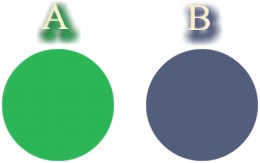
Since A and B cannot happen concurrently, the intersection of A and B in the Venn diagram above is empty.
General Case
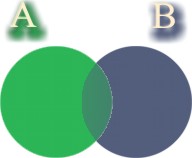
In the case when A and B can happen at the same time, the intersection of the two events in the Venn diagram below is non-empty.
Rule of Addition of Probability
Addition normally connotes the sum of two. In the study of Probability, this is also the case. The Addition Rule involves two events, let us say denoted by A and B, and it describes a way of calculating the probability of either A or B happening.
General Formula
The general formula for the probability of either one of two events, A or B, happening at all is:
Multiplication Rule of Probability
As is the case with the Addition Rule, the Multiplication Rule of Probability also involves two events, say A and B, and it describes a way of calculating the probability of A and B happening concurrently. This is generally called the "joint probability" of the two events.
General Formula
There are actually two formulae for calculating the joint probability of two events A and B, and they are:
Last Updated by SAS October 07, 2026, 16:00:54

