



Rule of Addition of Probability
Addition normally connotes the sum of two. In the study of Probability, this is also the case. The Addition Rule involves two events, let us say denoted by A and B, and it describes a way of calculating the probability of either A or B happening.
General Formula
The general formula for the probability of either one of two events, A or B, happening at all is:
Simplest Case
The simplest case occurs when A and B cannot happen at the same time. In this case, A and B are said to be mutually exclusive (in other words, keep to themselves or don't mix with one another) and may be represented using a Venn diagram as follows.
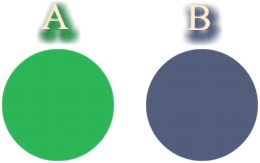
Because the intersection of A and B is empty, we may deduce that the probability of both happening at the same time is 0. That is,
We substitute this into the general formula above, to obtain that, for mutually exclusive events, the probability of either one of A or B happening is:
It now becomes a little clearer perhaps why this is called the "Addition Rule for Probability".
General Case
In the case when A and B can happen at the same time, the intersection of the events is non-empty. The Venn diagram for such a scenario is as follows.
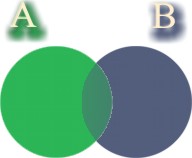
Because of the non-empty intersection, if we were simply to add the probabilities of A and B together, we would have added the intersection twice -- once in the probability of A, once in the probability of B. Therefore, when we obtain the general formula for the probability of either one of A or B happening, we must subtract the extra one out of the equation. Thus we obtain:
Last Updated by SAS October 07, 2026, 16:00:54

