



Multiplication Rule of Probability
As is the case with the Addition Rule, the Multiplication Rule of Probability also involves two events, say A and B, and it describes a way of calculating the probability of A and B happening concurrently. This is generally called the "joint probability" of the two events.
Simplest Case
The simplest case occurs when A and B cannot happen at the same time. In this case, A and B are said to be mutually exclusive (some text books use the term disjoint).
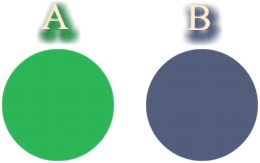
Since A and B cannot happen concurrently, the intersection of A and B in the Venn diagram above is empty. We may therefore deduce that the joint probability of A and B is 0, or
General Case
In the case when A and B can happen at the same time, the intersection of the two events in the Venn diagram below is non-empty.
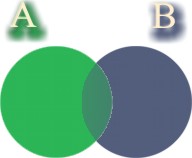
The joint probability of A and B measures the probability that an occurrence of both happening lies in the intersection. Now consider the following Venn Diagram of the event A on its own, keeping in mind that its intersection with B is not empty.

The likelihood that the outcome is already in A is measured by P(A).
Given the outcome is already in A, the likelihood that it is also in B is measured by the conditional probability P(B | A).
This leads us to the probability of an outcome being in the intersection is:
It is interesting that, if we consider the following Venn Diagram of the event B on its own, a similar type of logic leads us to an alternative formula for the joint probability of the events A and B.

The likelihood that the outcome is already in B is measured by P(B).
Given the outcome is already in B, the likelihood that it is also in A is measured by the conditional probability P(A | B).
This leads us to the probability of an outcome being in the intersection is:
General Formula
Consequently there are two formulae for calculating the joint probability of two events A and B, and they are:
Last Updated by SAS October 07, 2026, 16:00:54

