



Mutually Exclusive Events
When two events A and B cannot happen at the same time, they are said to be mutually exclusive (in other words, keep to themselves or don't mix with one another) and may be represented using a Venn diagram as follows.
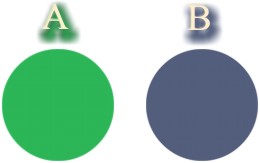
Because the intersection of A and B is empty (meaning that they have no common outcomes), we may deduce that the probability of both happening at the same time is 0. That is,
The Addition Law of Probability for mutually exclusive events A and B, which gives the probability of either one or the other of them happening, becomes:
Examples
Example using the Rule of Addition
Example comparing mutually exclusive events and independent events
Last Updated by SAS October 07, 2026, 16:00:54

