



Geometry
The Classical Greeks, the first to coin the term ‘geometry,’ believed that by understanding the principles of shape, form and symmetry, they could describe the entire world. It was they who described five, so-called, ‘perfect’ shapes:
the tetrahedron (4 faces) |
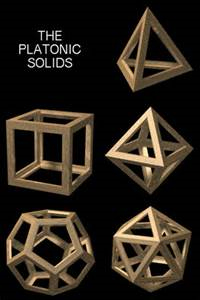
Photo courtesy of: http://liv.ac.uk |
the cube (6 faces) and the octahedron (8 faces) |
|
the dodecahedron (12 faces) the icosahedron (20 faces) |
These geometric shapes were called the Platonic solids because Plato (circa 429–347 B.C.), a Classical Greek mathematician and philosopher, allegedly believed that they were the building blocks of nature. Their perfection lay in the fact that the faces on each of these solids were all the same shape and met at the same angles – a instance of quintessential symmetry which was not spherical. Nonetheless, though this may seem a rather naïve belief to us of the digitalized world of the twenty-first century, these ancient Greeks may have inadvertently tapped into the shapes that do, in fact, create all nature.
Watch the YouTube video, The Code: Shapes narrated by Professor Marcus Du Satory of Oxford University in collaboration with the Open University of the United Kingdom and the BBC, to discover more about how shapes have determined our study of geometry and how geometry has shaped our understanding of the world in which we live.
Last Updated by SAS October 07, 2026, 16:00:47

