



The GEOMETRY of SAND DUNES
Sand dunes occur on almost every continent on the globe, creating a kaleidoscope of shapes in large desert regions or along many coastal waters. Some move from one place to another; others are seemingly static sculptures in the landscape. They may be classified as crescentic, linear, star-shaped, dome-like, parabolic or longitudinal.
Apart from the very well known Sahara Desert in North Africa, Death Valley in the United States of America, the Gobi Desert in Mongolia, the Arabian Desert in the Middle East, the Thar Desert in India, and the Great Victoria Desert in Australia, there are lesser known dry desert regions on every continent of the globe. The entire continent of Antarctica is considered, by some definitions, to be the largest desert in the world. Below (top left moving clockwise) are images of the White Desert in Brazil, a Canadian desert region in southern British Columbia, the Piscinas Desert in Sardinia, and the Chara Desert in Siberia.
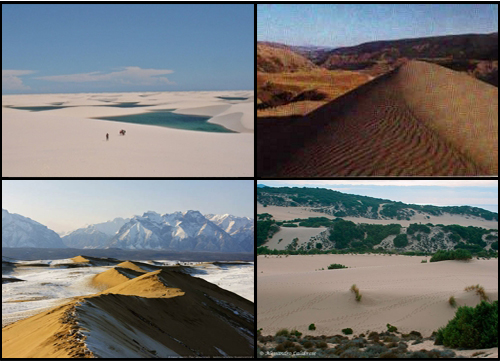
Photos courtesy of http://www.bing.com/
As with many other natural processes on the planet, they may also be mathematically modeled in terms of standardized geometric shapes, force vectors, movement and angles of inclination (see the diagram below).
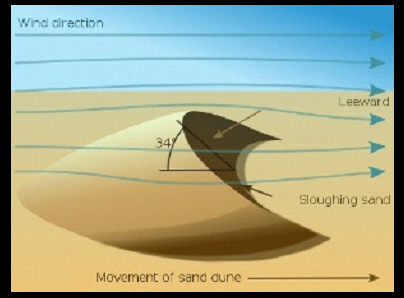
Photo courtesy of http://www.bing.com/
However, if you live amongst the ever-shifting dunes of a desert, it then becomes almost imperative to understand them, how they are formed, in what directions they move and how they can be ‘controlled.’ Mohammad Zuheir Abu-Sbeih, a mathematics professor at King Fahd University of Petroleum and Minerals in Dharan, Saudi Arabia, has provided some insights into how Saudi Arabian researchers have endeavoured to solve some of these issues. In the video below, he highlights the mix of geography, physics, chemistry and mathematics used to study the topography of the desert landscape around them.
How Are Sand Dunes Formed? (courtesy of Read the Understory)
This video was sponsored by Saudi Aramco and produced by the Sultan Bin Abdel Aziz

