



TRIGONOMETRIC FUNCTIONS
When the radian measure of angles was introduced in the early eighteenth century by Roger Cotes (1682-1716) and the trigonometric ratios of angles in the plane began to be viewed as functions of a linearized angle, the undulating movement of the sine and cosine graphs fed the imaginations of scientists working in areas as diverse as: the swinging motions of pendula, the vibration of musical notes, the ebb and flow of tides, electromagnetic radiation waves, the modeling of alternating electrical currents, and other physical phenomena on or near the earth’s surface.
Not long after Cotes’ discoveries, a Swiss mathematician, Leonard Euler (1707-1783), introduced the symbolism  to represent the value of a function, called
 , at the real number x . This paved the way for the definition of trigonometric ratios to be defined as functions from the real number line (the angle measured in radians) into itself (the trigonometric ratio of the angle). For example, the sine function could then be defined as:
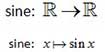
where both the domain and target sets of the sine function were  , the set of all real numbers.
Specific values include:
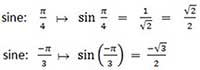
These, at the time new, developments revolutionized the study of the trigonometric functions and ultimately led to a visual depiction of their graphs in the Cartesian plane. The spin-offs of the applications of the sine and cosine waves alone have impacted the fields of physics and engineering rather profoundly.
What is truly phenomenal is that even quite general functions, which may not necessarily be strictly harmonic in nature, can be represented and approximated (under certain conditions) by sums of relatively simple trigonometric functions. The study of the ways this can happen is called ‘Fourier Analysis,’ named after the French mathematician and physicist, Joseph Fourier (1768–1830), who showed that representing a function as a sum of trigonometric functions greatly simplified the study of the propagation of heat.
Today, Fourier Analysis, with its foundational roots in the six basic trigonometric functions, has numerous scientific applications – in physics, signal processing, imaging, probability theory, statistics, option pricing, cryptography, acoustics, oceanography, sound navigation and ranging (sonar), optics, diffraction, protein structure analysis, to mention only some of them.
Last Updated by SAS October 07, 2026, 16:01:00

