


Donna Lawrence focuses on supporting marginalized communities through death and dying, while educating and advocating on behalf of fellow nurses
Donna Lawrence (Master of Nursing ’22) understands from experience how important it is to have support while you’re dealing with traumatic challenges in your life.
She’s overcome homelessness, domestic violence, and crippling self-doubt through perseverance and the ongoing support of the people around her. That’s a driving force in her own tireless work, volunteering her time to support and inspire her family, community, and her fellow nurses.
“It’s the give-back to my profession and society,” she said. “I want to be someone who not necessarily fixes, because it takes many hands to fix anything, but as someone who wants change and wants everyone in society to experience the greater good.”
For Lawrence, this has involved volunteering in many capacities, including board governance roles with several palliative care and hospice organizations, and hands-on roles focused on poverty alleviation and supporting the homeless community.
She has also spent her career as a nurse supporting some of the most vulnerable and marginalized people in society, while supporting and mentoring her fellow nurses and other health-care professionals.
Lawrence’s tireless efforts and dedication have earned her the 2026 Volunteer Service Award. This award recognizes an AU grad who has demonstrated a spirit of volunteerism and community service through unpaid involvement in, and contributions to, their community.
I want to be someone who not necessarily fixes, because it takes many hands to fix anything, but as someone who wants change and wants everyone in society to experience the greater good.
Donna Lawrence (Master of Nursing '22)
Overcoming adversity en route to nursing
Education was one of the main reasons Lawrence’s parents immigrated from Jamaica to England and then to Canada—they wanted their children to have better educational opportunities than they did.
After settling in Ontario, first in Toronto and then in Guelph, Lawrence’s parents emphatically encouraged both religion and education. Lawrence attended church and Sunday school from preschool through Grade 11.
There, she found community—which was not always easy, as theirs was the only Black family in the neighbourhood.
“That’s where the volunteering with me started,” she said. “It started with the pioneer clubs in church when I was little, and trying to find a sense of camaraderie.”
Although Lawrence did reasonably well in school, it was not always easy. Her parents pushed her to take advanced classes, which she often struggled with, having to make up credits during summer school. She felt like she was missing some of the fundamentals, in math in particular, which would become a challenge for her once she began to pursue nursing education many years later.
Lawrence wasn’t immediately drawn to university once she finished high school. Instead, she took a police foundations diploma program through Mohawk College. After short stints working security jobs and as a prison guard, she bounced around some factory jobs before training as a personal support worker, then registering for a nursing program.
Unfortunately, the struggles she had had with math were still there, and she was kicked out of her nursing program. She was told she could reapply, but this was at the time when Ontario’s RN requirements were changing from a three-year college program to a four-year university program.
“I turned my back on nursing for a good six or seven years,” she said.

Finding her path as a nurse
Meanwhile, Lawrence had personal struggles, including dealing with an “extremely abusive” and life-threatening relationship, causing her to leave Ontario.
“That’s what pushed me out west,” she said. “I moved to Winnipeg because this man I had a restraining order against just wouldn’t leave me alone.”
In Manitoba, she started a minimum-wage job at the airport before training as an educational assistant. Her colleagues lauded her ability to work with students and de-escalate challenging situations. Many suggested she should go back to nursing, and ultimately, she did.
In the third year of her program at the University of Manitoba, Lawrence had a baby, which was extremely challenging while trying to complete an undergraduate degree. Fortunately, her friends and colleagues helped support her, even with simple things like taking the baby for an hour while she had class.
She struggled with finances, in part because of the costs associated with trying to sponsor her child’s father to immigrate from Scotland. Things became even more challenging. Lawrence’s living situation became untenable after an incident where her roommate threatened her son.
“I knew if I didn’t move out that night, and go live in my van with my baby, I was going to end up in jail, and he was going to end up in foster care,” she said.
She overcame this challenge, too, with the support of friends, classmates, and colleagues. With her degree in hand, she moved back to Ontario and began her career as a nurse.
A passion for palliative care
Lawrence’s nursing career began with short stints in part-time roles in hospitals, community settings, care homes, and colleges. She soon realized she had a passion for palliative care, even though death and dying was not something she had had a lot of experience with.
“I come from a very death-phobic family, and a very death-phobic culture,” she said.
She wanted a single, full-time role to replace her hectic part-time schedule, which she found at Hospice Wellington. The evening of her first shift, the hospice held a gala, where she heard stories of the impact palliative and hospice care had had on patients and their families. She realized she had found a role that would make a profound impact on people who needed it.
“It was the personal testimonies of the engagement with the staff, the support that was offered, the one-to-one bereavement support and programming for family members,” she said. “And the notion that people only die once, but people working in healthcare [behave as though] this person has gone through it before.”
Palliative care became Lawrence’s professional focus, supporting patients and their families and taking on leadership and educator roles.
She eventually worked as director of care at a challenging facility in a poor area of downtown Hamilton, Ont. There were major drug problems in the neighbourhood, and she even had residents trying to sell drugs from the facility.
Through teaching roles at that facility, she got to know many nursing leaders in the community. When one encouraged her to pursue a master’s degree, she decided it was time.
“It ate at me like a fungus, and I couldn’t get it out of my brain for three weeks.”
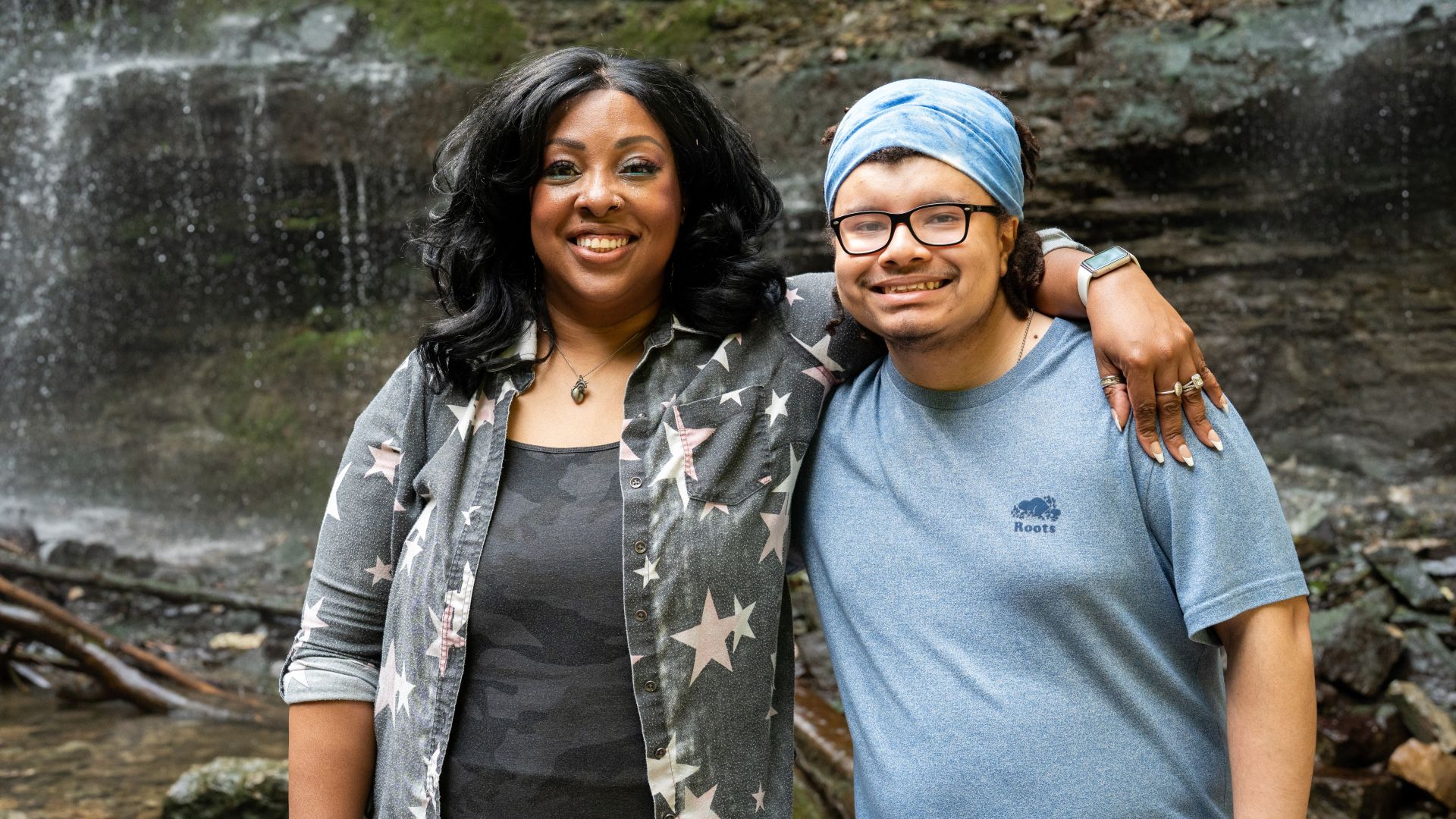
Donna Lawrence with her son.
Education and advocacy
Lawrence applied to AU and was accepted. Like so many AU students, she had full-time work, family, and volunteer commitments that would have made a traditional bricks-and-mortar university program impossible for her.
“I was working full time as a director of care, 24 hours a day on call, homeschooling my son full time, and I have a chronic illness,” she said. “If it wasn’t for Athabasca University and having a distance-education Master of Nursing program, I would not have my master’s right now.”
Paying for one course at a time, she finished the program and turned her focus to her two passions in volunteering: palliative care and supporting Black nurses.
One of the volunteer roles Lawrence is most proud of is with Black Nurses Leading Change (BNLC), an organization within the Registered Nurses’ Association of Ontario to advocate on behalf of Black nurses and students. She has served as an executive member since 2022.
“BNLC was all about taking care of my mental health but also being there for nursing students who are coming up, as well as for nurses in the field who are going through something similar, just to be that source of support,” she said.
Lawrence also works with the Home Hospice Association (HHA), a grassroots volunteer organization doing meaningful end-of-life work. This non-hospice palliative care volunteer support organization is the first in Canada to run a death doula program.
She's proud to be a HHA board member, collaborating to support diverse, marginalized communities with death and dying, including folks in prison, 2SLGBTQ+ communities, and the unhoused. At its core, this work is about leaving the world better than she found it and serving as an inspiration for her family and community.
“Waking up every day is a blessing. We don’t know when we’re going to go, so it’s very much about making your life count,” she said. “It would be sad if something happened to me tomorrow and there was nothing for me to leave behind.”